
Reading Toni 2026
a 2026 reading challenge

Known for critical portrayals of racism and the Black American experience in the United States, novelist and editor Toni Morrison is regarded as a cultural giant in the African American and literary communities. In 2026, I’m challenging myself — and you all — to deep dive into Morrison’s backlist.
Below, you’ll find more details on how to participate in this challenge, synopses for each book, and other resources. I’m excited to start this journey with you all and happy reading!
Table of Contents
I. The Rules
II. The Books
III. Other Resources
I. The Rules
Read all 11 of Toni Morrison’s novels in the order they were published
Optional: Feel free to post your experience online and tag me @ shay.thereader on Instagram, TikTok, or YouTube and use the hashtag #ReadingToni2026
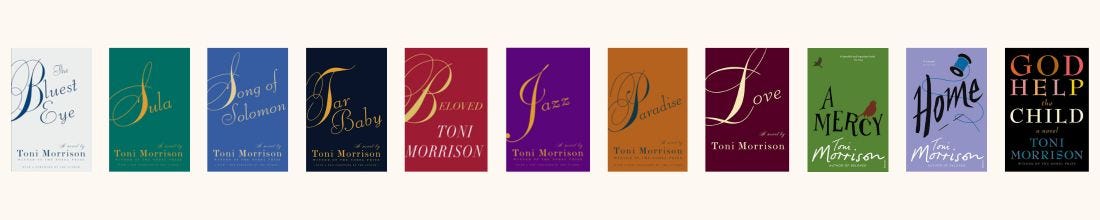
II. The Books
DISCLOSURE: I am Bookshop affiliate and will earn a commission if you click a book link and make a purchase.
1. The Bluest Eye (1970)
In Morrison’s acclaimed first novel, Pecola Breedlove—an 11-year-old Black girl in an America whose love for its blond, blue-eyed children can devastate all others—prays for her eyes to turn blue: so that she will be beautiful, so that people will look at her, so that her world will be different. This is the story of the nightmare at the heart of her yearning, and the tragedy of its fulfillment.
2. Sula (1973)
Sula and Nel are born in the Bottom—a small town at the top of a hill. Sula is wild, and daring; she does what she wants, while Nel is well-mannered, a mamma’s girl with a questioning heart. Growing up they forge a bond stronger than anything, stronger even than the dark secret they have to bear. Strong enough, it seems, to last a lifetime—until, decades later, as the girls become women, Sula’s anarchy leads to a betrayal that may be beyond forgiveness.
3. Song of Solomon (1977)
Milkman Dead was born shortly after a neighborhood eccentric hurled himself off a rooftop in a vain attempt at flight. For the rest of his life he, too, will be trying to fly. As Morrison follows Milkman from his rustbelt city to the place of his family’s origins, she introduces an entire cast of strivers and seeresses, liars and assassins, the inhabitants of a fully realized Black world.
4. Tar Baby (1981)
Jadine Childs is a Black fashion model with a white patron, a white boyfriend, and a coat made out of ninety perfect sealskins. Son is a Black fugitive who embodies everything she loathes and desires. As Morrison follows their affair, which plays out from the Caribbean to Manhattan and the deep South, she charts all the nuances of obligation and betrayal between Blacks and whites, masters and servants, and men and women.
5. Beloved (1987)
Sethe was born a slave and escaped to Ohio, but eighteen years later she is still not free. Sethe has too many memories of Sweet Home, the beautiful farm where so many hideous things happened. And Sethe’s new home is haunted by the ghost of her baby, who died nameless and whose tombstone is engraved with a single word: Beloved.
6. Jazz (1992)
In the winter of 1926, when everybody everywhere sees nothing but good things ahead, Joe Trace, middle-aged door-to-door salesman of Cleopatra beauty products, shoots his teenage lover to death. At the funeral, Joe’s wife, Violet, attacks the girl’s corpse.
7. Paradise (1998)
“They shoot the white girl first. With the rest they can take their time.” So begins Toni Morrison’s Paradise, which opens with a horrifying scene of mass violence and chronicles its genesis in an all-black small town in rural Oklahoma. Founded by the descendants of freed slaves and survivors in exodus from a hostile world, the patriarchal community of Ruby is built on righteousness, rigidly enforced moral law, and fear. But seventeen miles away, another group of exiles has gathered in a promised land of their own. And it is upon these women in flight from death and despair that nine male citizens of Ruby will lay their pain, their terror, and their murderous rage.
8. Love (2003)
In life, Bill Cosey enjoyed the affections of many women, who would do almost anything to gain his favor. In death his hold on them may be even stronger. Wife, daughter, granddaughter, employee, mistress: As Morrison’s protagonists stake their furious claim on Cosey’s memory and estate, using everything from intrigue to outright violence, she creates a work that is shrewd, funny, erotic, and heartwrenching.
9. A Mercy (2008)
In the 1680s the slave trade in the Americas is still in its infancy. Jacob Vaark is an Anglo-Dutch trader and adventurer, with a small holding in the harsh North. Despite his distaste for dealing in “flesh,” he takes a small slave girl in part payment for a bad debt from a plantation owner in Catholic Maryland. This is Florens, who can read and write and might be useful on his farm. Rejected by her mother, Florens looks for love, first from Lina, an older servant woman at her new master’s house, and later from the handsome blacksmith, an African, never enslaved, who comes riding into their lives.
10. Home (2012)
When Frank Money joined the army to escape his too-small world, he left behind his cherished and fragile little sister, Cee. After the war, he journeys to his native Georgia with a renewed sense of purpose in search of his sister, but it becomes clear that their troubles began well before their wartime separation. Together, they return to their rural hometown of Lotus, where buried secrets are unearthed and where Frank learns at last what it means to be a man, what it takes to heal, and—above all—what it means to come home.
11. God Help the Child (2015)
At the center: a young woman who calls herself Bride, whose stunning blue-black skin is only one element of her beauty, her boldness and confidence, her success in life, but which caused her light-skinned mother to deny her even the simplest forms of love. There is Booker, the man Bride loves, and loses to anger. Rain, the mysterious white child with whom she crosses paths. And finally, Bride’s mother herself, Sweetness, who takes a lifetime to come to understand that “what you do to children matters. And they might never forget.”
III. Other Resources
Toni at Random: The Iconic Writer’s Legendary Editorship by Dana A. Williams
A multifaceted genius, Toni Morrison transcended her role as an author, helping to shape an important period in American publishing and literature as an editor at one of the nation’s most prestigious publishing houses. While Toni Morrison’s literary achievements are widely celebrated, her editorial work is little known. Drawing on extensive research and firsthand accounts, this comprehensive study discusses Morrison’s remarkable journey from her early days at Random House to her emergence as one of its most important editors. During her tenure in editorial, Morrison refashioned the literary landscape, working with important authors, including Toni Cade Bambara, Leon Forrest, and Lucille Clifton, and empowering cultural icons such as Angela Davis and Muhammad Ali to tell their stories on their own terms.
Toni Morrison herself had great enthusiasm about Dana Williams’s work on this story, generously sharing memories and thoughts with the author over the years, even giving her the book’s title. From the manuscripts she molded, the authors she nurtured, and the readers she inspired, Toni at Random demonstrates how Toni Morrison has influenced American culture beyond the individual titles or authors she published. Morrison’s contribution as an editor transformed the broader literary landscape and deepened the cultural conversation. With unparalleled insight and sensitivity, Toni at Random charts this editorial odyssey.
On Morrison by Namwali Serpell
Pub date: 17 February 2026
Toni Morrison, Nobel Laureate and one of our most beloved writers, has inspired generations of readers. But her artistic genius is often overshadowed by her monumental public persona, perhaps because, as Namwali Serpell puts it, “she is our only truly canonical black female writer—and her work is highly complex.” In On Morrison, Serpell brings her unique experience as both an award-winning writer and a professor who teaches a course on Morrison to illuminate her masterful experiments with literary form.
This is Morrison as you’ve never encountered her before, a journey through her oeuvre—her fiction and criticism, as well as her lesser-known dramatic works and poetry—with contextual guidance and original close readings. At once accessible and uncompromisingly rigorous, On Morrison is a primer not only on how to read one of the most significant American authors of all time but also on how to read great works of literature in general. This dialogue on the page between two black women artist-readers is stylish, edifying, and thrilling in its scope and intelligence.
Toni Morrison: The Pieces I Am
Toni Morrison talks about life and writing in this documentary exploring the themes of race, America and the human condition throughout her work.
if you’re looking for more ways to support me or this newsletter, buy me a book!
2026 bookish goals and challenges

It’s that time of year to talk about the bookish goals, challenges, and habits I’m taking into the New Year! In 2025, I made the leap towards more holistic goals, rather than focusing on a numerical goal I may or may not meet. (You’ll see one below, but it’s nothing compared to the goals I’ve set in pervious years.) I’m hoping to push myself a bit furth…

Adding Recitatif to my list for December. Thanks for this. I own all of her novels and a few of her books of essays. Can't honestly say, at the moment, that I own all she's published.
Thank you so much for doing this! I read all of her novels chronologically in 2024, plus many essays, speeches, interviews, etc. Hoping to join in and revisit this year.